SOTO WindMaster Stove with 4Flex Review
The SOTO WindMaster OD-1RX is a regulated, ultralight canister stove that earns its name — a top pick for thru-hikers and backpackers who cook in unpredictable conditions.
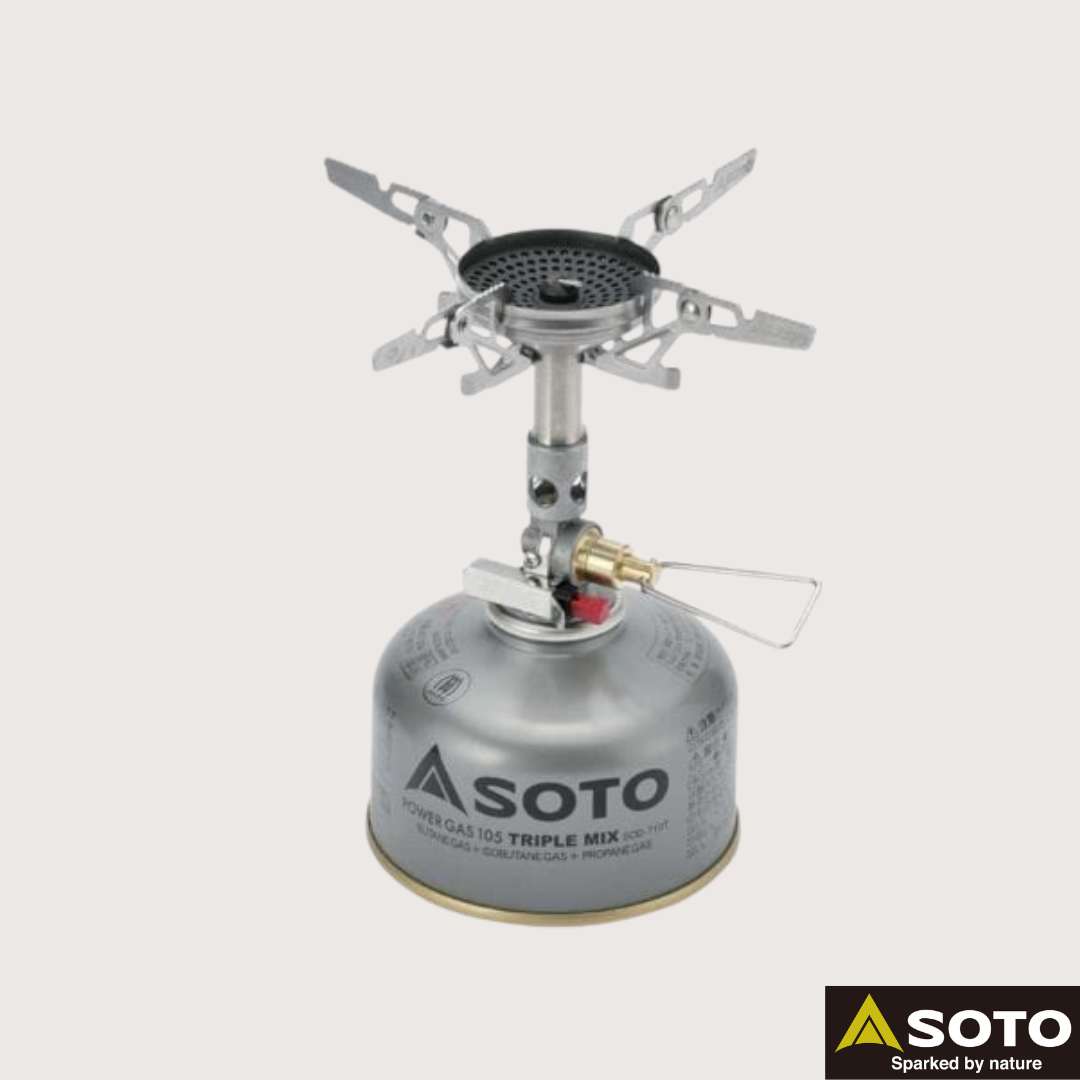
Overview
The SOTO WindMaster upright canister stove has been on the market since 2013, improving upon Soto’s earlier Micro Regulator by going lighter and building wind resistance directly into the design.
It pairs a recessed, concave burner head with a micro regulator valve and a spring-loaded, four-prong pot support to deliver a genuinely wind-capable stove without the weight penalty of a windscreen.
It ranks as the highest-rated stove on the Pacific Crest Trail, based on 846 completed surveys from the Class of 2019
— which tells you who’s actually reaching for this thing in the field.
Key Specs
| Spec | Value |
|---|---|
| Model | OD-1RX |
| Weight (with 4Flex) | 87 g / 3.0 oz |
| Weight (with TriFlex, sold separately) | 67 g / 2.3 oz |
| Weight (stove only) | 60 g / 2.1 oz |
| Output | 11,000 BTU / 2,800 kcal/h / 3,260 W |
| Burn Time | ~1.5 hrs (250 g canister) |
| Boil Time | Under 2.5 min for 2 cups (in wind) |
| Max Pot Diameter | 2 L |
| Packed Dimensions (4Flex) | 1.9 × 3.0 × 1.7 in (47 × 77 × 44 mm) |
| Igniter | Built-in piezo |
| Fuel | Isobutane/butane/propane canister |
| Pot Support | 4Flex (4-prong, removable, spring-loaded) |
Need to organize your gear?
Packstack is the free app that helps backpackers build a gear database, create detailed packing lists, and share their setup with friends.
Create Free AccountPerformance
Wind Resistance
This is where the WindMaster earns its name and separates itself from the competition. The burner head is recessed slightly below the outer housing, and the low-profile pot supports bring the bottom of your cookpot closer to the flame compared to many other stoves — features that combine to minimize the amount of flame exposed to wind. In practice, the WindMaster never needed a windshield across extensive multi-day treks including notoriously exposed Scandinavian routes. One user even reported cooking successfully through gusts up to 50–60 mph in Iceland. That said, the WindMaster is still an upright canister stove, and extreme alpinist conditions — sustained roaring winds, deep cold — are better handled by a remote-canister or integrated system like the MSR Windburner.
Boil Speed & Fuel Efficiency
In a controlled indoor test with an aluminum pot and a full canister at full power, 500 ml of room-temperature water reached a rolling boil in 1 min 53 sec, using just 9 g of fuel.
In a separate comparative test, the WindMaster boiled 2 cups in 106 seconds, worked in the wind, and was the most fuel-efficient stove tested.
Zpacks puts the fuel draw at roughly about 1/4 oz (7 g) of fuel per 2-cup boil, which is genuinely efficient. On a long trip, that kind of fuel economy compounds fast — you may find yourself carrying less gas than you planned for.
Cold-Weather Performance
Soto’s micro regulator valve system improves efficiency and operation during cold weather, where many canister stoves begin to falter.
Users across high-altitude Rocky Mountain trips and winter conditions consistently report reliable performance without the canister-warming tricks often needed with unregulated stoves.
Simmer Control
The WindMaster excels at simmering, offering an excellent simmer relative to its size and allowing backcountry chefs to cook a variety of meals — the valve can be dialed down to barely on without the flame blowing out.
The flame forms a flat, pan- or pot-hugging disc that spreads heat out better than torch-type burners.
This makes a real difference if you’re doing anything beyond instant ramen — eggs, fish, a proper pasta sauce. It’s quieter in operation than competing stoves too:
the WindMaster was one of the quietest backpacking stoves tested, especially compared to the conversation-killing PocketRocket.
The 4Flex Pot Support
The 4Flex legs flip out and provide one of the widest support diameters seen in a canister stove — about 5-5/8” (142 mm).
Over time, the 4Flex offers much more stability than the TriFlex, and with the arms simply folded in the stove is ready to pack away.
The downside is that the supports are a separate piece — more on that under Cons.
Igniter Reliability
After a decade-plus of field use across all conditions, one long-term reviewer found the piezo igniter required just one replacement — and it performed well even at altitude, though a backup ignition source is always worth carrying.
Soto doesn’t guarantee operation of the piezo above 10,000 feet, though in practice it has been used without issue to 11,000 feet.
Treat the piezo as your first option, not your only option.
Pros & Cons
Pros
- Genuinely wind-resistant without requiring an external windscreen — delivers on the name
- Micro regulator maintains consistent output in cold weather and as the canister empties
- Excellent simmer capability for a stove this light; flat, disc-like flame distributes heat evenly
- 4Flex supports are stable, wide, and work with pots up to 2 L
- Built-in piezo igniter is a genuine convenience and holds up well over time
-
Remarkably quiet operation — appreciated both in group camp and solo nature-listening situations
-
Weight includes an integrated piezo, so there’s no separate lighter to factor in — making the real-world weight advantage over lighter stoves even larger
Cons
-
The pot supports are not permanently attached to the stove and can be finicky to put back on if they fall off
— losing them in the field would be a trip-ender -
At 3.6” tall, the stove sits fairly high off the canister
, raising the system’s center of gravity; on uneven ground with a large pot and a small canister, it’s worth paying attention to stability -
The control valve could use a bit more resistance for fine adjustments
— at full output and in high-output mode it can feel touchy - At roughly $70, it’s one of the pricier options in the lightweight canister category
- Not suited for true winter inverted-canister use; a remote canister stove is the better call once temps stay consistently below freezing
- TriFlex support (the lighter, more packable option) is sold separately
Who Should Buy This
This stove is the right call for backpackers and thru-hikers who spend meaningful time above treeline or in exposed terrain where wind is a regular variable — PCT, CDT, long routes in the Rockies or Cascades, Iceland, Scandinavia. If you see yourself adventuring in cold, wet, and windy conditions, the WindMaster is worth the extra cost and weight over a basic canister stove. It’s also a strong choice for anyone who actually cooks in the backcountry rather than just boiling water — it’s excellent for anything from simmering to boiling water, and it’s especially capable for simmering, allowing real meals in the field. Gram-obsessed base-weight minimalists chasing sub-10 oz kitchen systems will likely prefer the lighter TriFlex version; the 4Flex combo reviewed here targets anyone cooking for two or using larger pots.
Verdict
The WindMaster with 4Flex is about as close to an all-around canister stove as the category offers: genuinely wind-resistant, micro-regulated, capable of a real simmer, and light enough to fit most ultralight systems without apology. The removable pot supports are a legitimate nuisance and the tall profile is worth watching on rocky ground, but neither is a dealbreaker. After seven years and more than 5,000 miles of testing side-by-side with other canister stoves, the WindMaster stands out as the best backpacking stove you can get — and based on widespread long-term user experience, that verdict holds up. 9.5/10.